Less gripping
Can you lift your arms without excessive tension in your shoulders or neck? Explore an easy height, with room to breathe.
 DaoAI
A thank-you for taking our survey
Our practice begins with a simple aim: soften unnecessary tension, find support, and let movement flow.
Explore the feelingWith care, Janet · DaoAI
Our traditional practice ideal
Can you lift your arms without excessive tension in your shoulders or neck? Explore an easy height, with room to breathe.
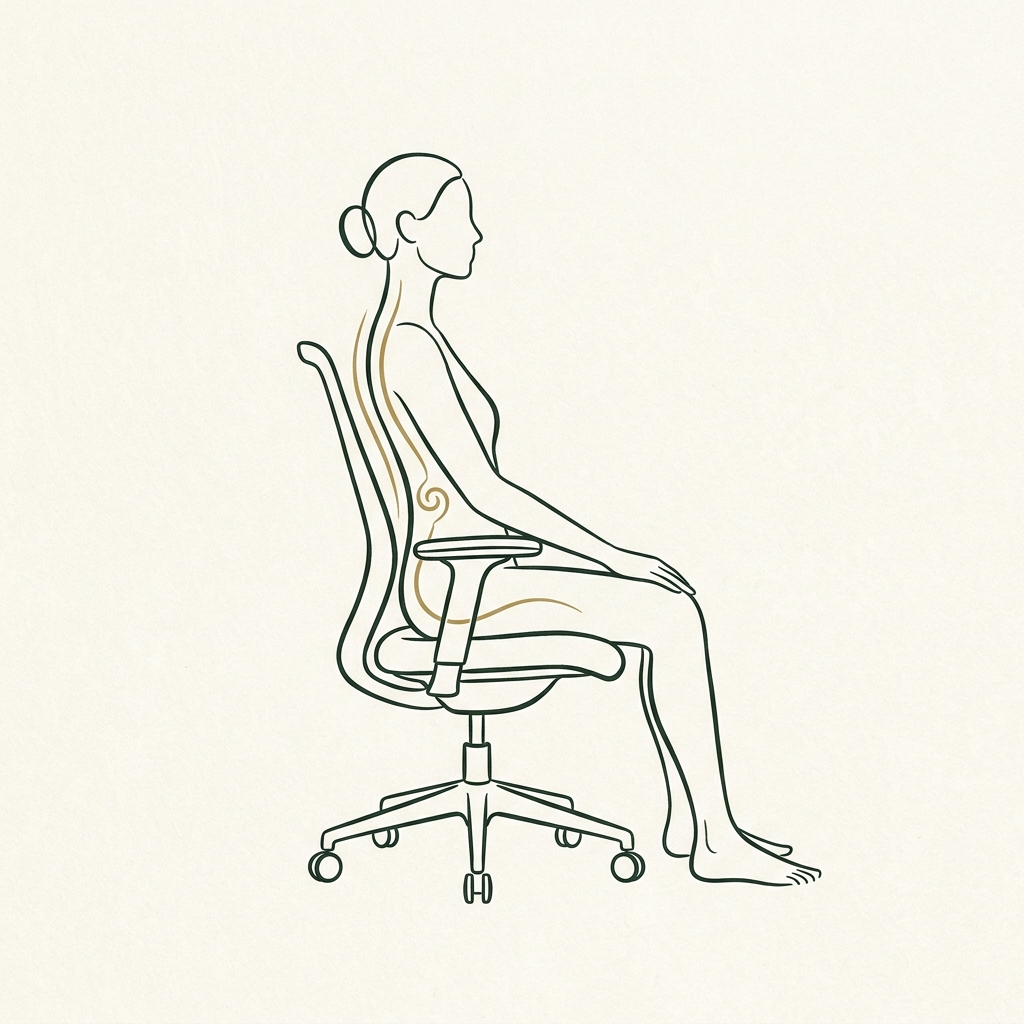
Your spine has natural curves. Muscles and connective tissues support it; our aim is to explore ease while keeping that support.
Can a small wave travel gradually through your upper back? Notice where the movement flows, and where it feels less coordinated.
We use these observations to guide gentle practice. Regular activity, changes of position and gradual strength-building also support everyday movement.
02 / An optional movement exploration
A small front-to-back wave lets you notice how different parts move together. Keep it slow and comfortable.
These sensations help you describe your experience. They don’t identify an injury or diagnose a spinal condition.
The DaoAI approach
My teacher’s desk practice uses small circles. Horizontal circles and vertical circles are separate movements; neither needs a forceful twist.
Horizontal / viewed from above
Picture a spinning top: its lower tip is a reference point, while the upper part traces a small, level circle. Use this image for a soft pelvic circle—not an attempt to twist the tailbone itself.
Small circle · steady feet · relaxed shoulders
Vertical / viewed from the side
The circle turns upright, in the front-to-back plane. It is a different movement from the horizontal orbit—and from the loose whole-body wave above.
Different plane · gentle range · no forced bend
Direction diagrams, not anatomical maps. For the full technique, learn the sequence with Janet rather than copying a still picture.
At your desk
Use a stable chair that won’t roll, with feet supported. Start small, pause often, and change position during the day. Two minutes can be a beginning—not a target to push through.
03 / Notice the difference
If comfortable, try the same small wave again. Notice shoulder tension, the flow through your upper back, and your breathing. No change is useful to notice too.
Your selection stays on this page until you choose to email it.
There is no score. Just notice what feels right for you today.
“Share” opens your email app. Nothing is submitted automatically.
Stop if a movement causes pain, dizziness, tingling or numbness. Seek advice from your GP or physiotherapist if symptoms persist or worsen. This guide offers movement education, not medical assessment or treatment.
New bladder or bowel control problems, numbness around the groin, or new or worsening leg weakness need urgent medical assessment. Do not use this guide to test these symptoms.